Why you should schedule regular deep cleans for your office

Picture a Monday morning in a busy London office. The weekend is over, the team files in, and on the surface everything looks fine. Bins were emptied on Friday, the floors were hoovered, and the kitchen was wiped down. But underneath the tidy appearance, bacteria have been multiplying on shared keyboards, allergens are settling into the carpet fibres, and a fine layer of grime has crept behind the monitors and along the skirting boards. By Wednesday, two members of staff have called in sick. By the end of the month, that pattern has quietly cost the business far more than a professional clean ever would.
If your office only benefits from a routine daily or weekly clean, you are not getting the full picture on workplace hygiene. Scheduling regular deep cleans is one of the most straightforward steps a business can take to protect its people, its assets, and its professional reputation. Here, we explain why, and how to build a schedule that actually works.
Key takeaways
- A deep clean addresses built-up grime, pathogens, and allergens that routine cleaning cannot reach.
- Regular deep cleans are directly linked to fewer sick days, better air quality, and higher staff productivity.
- Most offices should schedule a professional deep clean every one to three months, with additional cleans triggered by specific events.
- A clean, well-maintained office sends a powerful signal of professionalism to clients and candidates alike.
- Partnering with an accredited commercial cleaning company ensures COSHH-compliant products, trained operatives, and consistent, accountable results.
What a deep clean actually involves
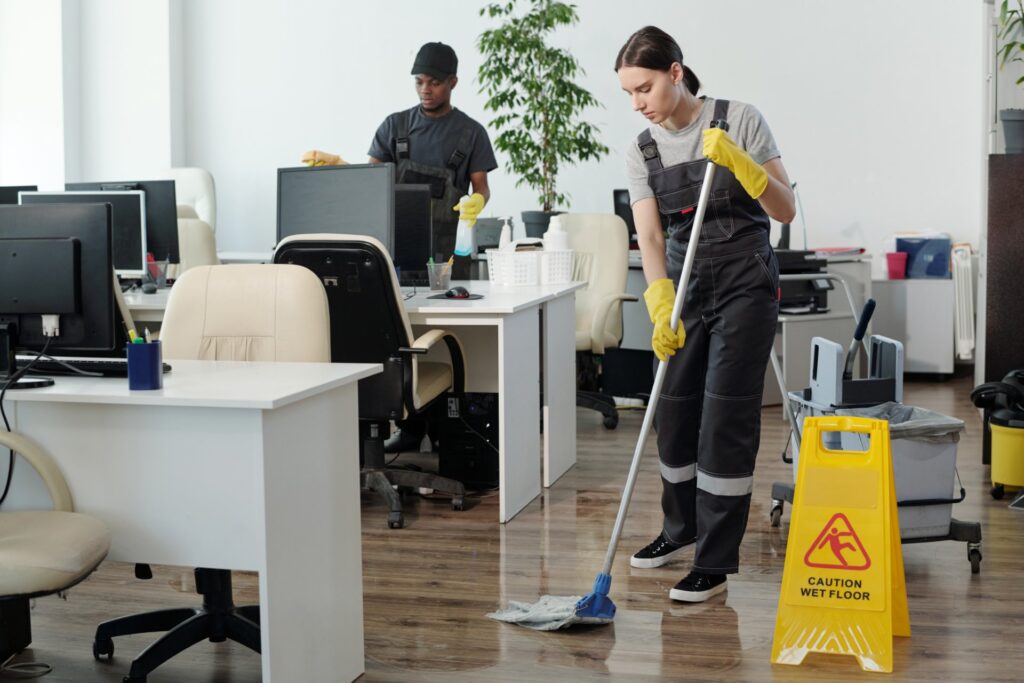
It helps to be clear about what separates a deep clean from the routine maintenance your office receives day to day. A routine clean keeps a workplace presentable: floors are vacuumed or mopped, surfaces wiped, bins emptied, and kitchen areas tidied. It is essential, but it is not exhaustive.
Routine clean
Scheduled daily or weekly. Covers visible surfaces, floors, bins, and communal kitchen areas. Maintains baseline hygiene and appearance.
Deep clean
Scheduled monthly, quarterly, or at trigger points. Addresses hard-to-reach areas behind and beneath furniture, sanitises high-touch points at a microbiological level, treats upholstery and carpets, degreses kitchen equipment, cleans air vents, and removes accumulated grime from fixtures and fittings.
The distinction matters because pathogens, allergens, and chemical residues do not respect the areas your routine clean covers. They settle into carpet pile, accumulate on the underside of desks, and build up inside ventilation systems. Only a structured, thorough deep clean removes them reliably.
Health, productivity, and morale
The air your team breathes
Indoor air quality is a genuine workplace health concern. According to the EPA guide to indoor air quality in office buildings, indoor pollutant levels can be two to five times higher than outdoor levels, with office carpets, furnishings, and HVAC systems all acting as reservoirs for dust, mould spores, and volatile organic compounds. The OSHA indoor air quality guidelines for workplaces recognise that poor air quality contributes directly to headaches, fatigue, and respiratory problems among office workers, all of which erode concentration and output.
A professional deep clean addresses this at the source: carpets are treated, upholstery is sanitised, and ventilation grilles are cleared of the accumulated dust that recirculates allergens through your workplace every time the heating or air conditioning runs.
Reducing sick days

Shared surfaces are the primary transmission route for the viruses and bacteria that circulate through offices. Keyboards, door handles, lift buttons, communal kitchen taps, and printer touchscreens are touched dozens of times each day, yet they fall outside the scope of most routine cleaning schedules. The CDC guidance on workplace hygiene and reducing sick days is clear that consistent hygiene practices in the workplace reduce illness transmission significantly.
The data backs this up. A peer-reviewed study on workplace hygiene and absenteeism reduction, published via the U.S. National Library of Medicine, tracked the outcomes of a structured workplace hygiene programme over 13.5 months and found measurable reductions in absenteeism and employer health care costs. For a business of any size, fewer sick days translate directly into maintained productivity, lower cover costs, and a healthier team culture.
A single illness outbreak spreading through an office can cost far more in lost productivity and temporary cover than an entire year of scheduled professional deep cleans.
Morale and the unspoken message your office sends
The physical environment shapes how people feel about their work. A visibly clean, well-maintained office tells your team that their wellbeing matters to the business. Conversely, grimy communal areas, stained upholstery, and persistent unpleasant odours quietly signal neglect, and that signal affects engagement. This is not about aesthetics alone. It is about the kind of workplace culture a business chooses to project. As a commitment to quality, sustainability, and client satisfaction sits at the heart of how we work, we see this reflected consistently in the feedback our clients share with us.
The productivity argument is compelling too. A real-world case study: office deep cleaning boosts productivity by 20% documented a technology firm that tracked a 20% increase in productivity and a 34% reduction in sick days following a professional deep clean programme. The results will vary by organisation, but the directional evidence is consistent.
Protecting your assets and professional image
Office fit-outs represent a significant capital investment. Carpets, seating, kitchen equipment, and specialist flooring all deteriorate faster when they are not properly maintained. Ingrained dirt is abrasive. Grease build-up in kitchen areas becomes a hygiene and fire risk. Mould that develops in poorly maintained bathrooms or around window frames causes structural damage that is expensive to remediate.
Regular deep cleaning extends the lifespan of your assets by removing the damaging residues that routine cleaning leaves behind. From a purely financial standpoint, the cost of periodic professional deep cleans is consistently lower than early replacement or reactive repairs.
There is also the matter of first impressions. When a client, prospective employee, or senior stakeholder walks into your office, the cleanliness of the space communicates something about how the business operates. A pristine environment signals attention to detail, care for people, and operational standards that extend beyond the visible. A neglected one does the opposite.
How often should you schedule a deep clean

A practical guide by office size and use
There is no single answer that fits every workplace, but the following framework gives most businesses a reliable starting point.
Small offices (fewer than 20 people, low visitor footfall)
a thorough deep clean every three months, supplemented by consistent daily or weekly routine cleaning, is typically sufficient.
Medium offices (20 to 100 people, regular client visits)
monthly or bi-monthly deep cleans better reflect the volume of surface contact and the importance of maintaining a client-ready environment at all times.
Large or high-traffic offices (100-plus people, public-facing areas, shared kitchens and breakout spaces)
monthly deep cleans are advisable, with additional attention to high-use zones such as reception, catering areas, and shared meeting rooms.
Regulated sectors (healthcare, legal, financial services)
frequency requirements may be dictated by compliance obligations. Our CQC-compliant medical cleaning services in London are designed specifically for environments where hygiene standards are non-negotiable.
Good to know: industry-recognised standards such as those maintained by the ISSA cleaning industry standards and GBAC accreditation body provide a benchmark for what a professional deep clean should achieve. When you appoint a cleaning partner, it is worth asking which standards their processes are aligned with.
Key triggers for an unscheduled deep clean
Beyond your regular schedule, certain events call for an immediate, thorough deep clean regardless of when the last one took place.
- A noticeable illness outbreak affecting multiple staff members in a short period.
- The completion of building works, refurbishment, or a significant office reconfiguration (construction dust penetrates everywhere).
- A change of tenancy, whether you are moving in or preparing a space to hand back.
- A large client showcase, industry event, or media visit where the environment will be scrutinised.
- Any incident involving flooding, leaks, or pest activity.
Building a deep cleaning schedule that works
The most effective deep cleaning programmes are planned in advance, not arranged reactively when a problem becomes visible. Here is how to set one up properly.
- Audit your current cleaning baseline. Identify what your routine contract covers and where the gaps are. High-touch surfaces, upholstery, and air vents are the most common blind spots.
- Map your office against the frequency guide above. Factor in headcount, visitor volume, sector-specific obligations, and any areas of particular concern such as shared kitchens or server rooms with sensitive equipment.
- Set calendar anchors. Block out your deep clean dates for the year and treat them as fixed commitments, the same way you would schedule a fire safety check or equipment servicing.
- Brief your cleaning partner in advance. A professional team needs clear access instructions, details of any sensitive equipment or materials, and any COSHH considerations relevant to your sector. COSHH (Control of Substances Hazardous to Health) regulations govern how cleaning chemicals must be used and stored safely, and a compliant provider will manage this on your behalf.
- Review and adjust quarterly. Track whether sick day patterns change. Ask staff for feedback. Note any areas that need more frequent attention and refine your schedule accordingly.
A deep cleaning schedule is not an added expense. It is a structured investment in the health of your people and the longevity of your workplace.
Choosing the right professional deep cleaning service
Not all cleaning providers are equal, and for a deep clean the difference in quality between an accredited specialist and a generalist contractor is significant. When evaluating providers, look for the following.
- Documented quality and environmental credentials, such as ISO 9001 and ISO 14001 certification.
- BICSc-trained operatives. BICSc (the British Institute of Cleaning Science) is the industry's leading professional body, and its accreditation signals that staff are trained to a measurable standard.
- A demonstrable track record with businesses similar to yours, across size, sector, and service scope.
- Transparent COSHH-compliant product usage, including eco-friendly alternatives where appropriate.
- Strong client retention. A company that retains 95% of its clients year on year is one whose results speak for themselves.
As a family-run commercial cleaning company with 35 years' experience, we have built our reputation on exactly these foundations. It is why businesses across sectors continue to trust us year after year, and it is what informs why businesses across London choose Total Clean when the standard of their workplace environment truly matters.
Frequently asked questions
What is the difference between a deep clean and a routine office clean?
A routine clean covers daily or weekly tasks such as vacuuming, emptying bins, and wiping surfaces. A deep clean goes further, addressing built-up grime in hard-to-reach areas, sanitising high-touch points thoroughly, cleaning behind furniture and equipment, and treating upholstery, carpets, and air vents. It is typically carried out monthly, quarterly, or at key trigger points such as after refurbishment or an illness outbreak.
How often should an office be deep cleaned?
Most offices benefit from a professional deep clean every one to three months, depending on headcount, foot traffic, and sector. High-traffic or client-facing spaces may need monthly deep cleans, while quieter back-office environments can often manage quarterly. We recommend reviewing your schedule after any significant trigger event such as a staff illness outbreak, building works, or a change of tenancy.
Can regular deep cleaning reduce employee sick days?
Yes. A peer-reviewed study published via the U.S. National Library of Medicine found that structured workplace hygiene programmes meaningfully reduced absenteeism and employer health care costs. Bacteria and viruses accumulate on shared surfaces such as keyboards, door handles, and kitchen worktops, and a thorough deep clean removes pathogens that routine daily cleaning cannot reach.
What triggers an unscheduled deep clean?
Common triggers include a noticeable illness outbreak among staff, the completion of a construction or refurbishment project, a new tenancy or office handover, a significant visitor event or client showcase, and any post-flood or water-damage remediation. In regulated sectors such as healthcare, an unscheduled deep clean may also be required to maintain compliance.
How do I choose a professional deep cleaning company for my office?
Look for a company with documented quality credentials such as ISO 9001 and ISO 14001, sector-specific experience relevant to your industry, BICSc-trained operatives, transparent COSHH-compliant product usage, and a strong client retention record. A company that has maintained relationships with clients over many years is a reliable indicator of consistent, accountable service.
Is it time to review your office cleaning schedule?
If your workplace relies solely on routine cleaning, the gaps in your hygiene programme are likely costing you more than you realise, in sick days, in staff morale, and in the impression your office makes on the people who walk through the door. Our deep cleaning services in London are carried out by trained, accredited operatives using COSHH-compliant products, and are tailored to the specific demands of your space and sector. We also offer the full range of professional commercial cleaning services in London to keep your workplace performing at its best between deep cleans. Get in touch today for a free, no-obligation quote and we will put together a schedule that fits your business properly.
Related Posts

The Ultimate office cleaning checklist
Read More

7 Step Easy to Follow Veterinary Cleaning Checklist for Your Practice
Read More
Why Professional Cleaning Helps Accountants Maintain Trust with Clients
Read More
