The Ultimate office cleaning checklist

Picture a Monday morning. A client arrives for an 8:30 meeting, steps out of the lift, and the first thing they notice is an overflowing waste bin in the corridor, smeared glass on the boardroom door, and a faint smell from the kitchen that nobody can quite place. Before a word has been spoken, your office has made an impression. It is not the one you intended.
A clean, well-maintained workplace is not simply about appearances. It directly affects staff health, focus, and morale, and it signals to everyone who walks through the door that your organisation takes its responsibilities seriously. After more than 35 years providing commercial office cleaning services across the UK, we know that the difference between a workplace that feels right and one that quietly undermines confidence almost always comes down to one thing: a consistent, well-structured cleaning programme.
This guide is the ultimate office cleaning checklist you can put to work straight away. We have organised it by frequency and by area, so whether you are reviewing your in-house routine or briefing a new cleaning partner, every task has its place and nothing is left to chance.
What an office cleaning checklist actually does for you
A checklist is not a sign of distrust in your cleaning team. It is the mechanism by which good intentions become reliable outcomes. Without one, tasks slip through the gaps. With one, there is a shared standard everyone can be measured against.
The ISSA commercial cleaning standards for office buildings make the point clearly: consistent, documented cleaning programmes produce measurably better hygiene outcomes than ad hoc routines, regardless of how experienced the cleaning team is. Documentation also protects you. If a staff member raises a hygiene concern or an audit requires evidence of cleaning frequency, a completed checklist is your first line of reassurance.
Consistency, accountability, and integrity are not values we talk about. They are the structure within which every clean we carry out takes place.
There is also the question of resource allocation. Not every task needs doing every day. A well-designed checklist assigns the right frequency to each task, reducing wasted effort and ensuring that the heavier, more time-consuming jobs such as carpet extraction or high-surface dusting happen often enough to matter but not so often that they eat into budget unnecessarily.
Daily office cleaning tasks
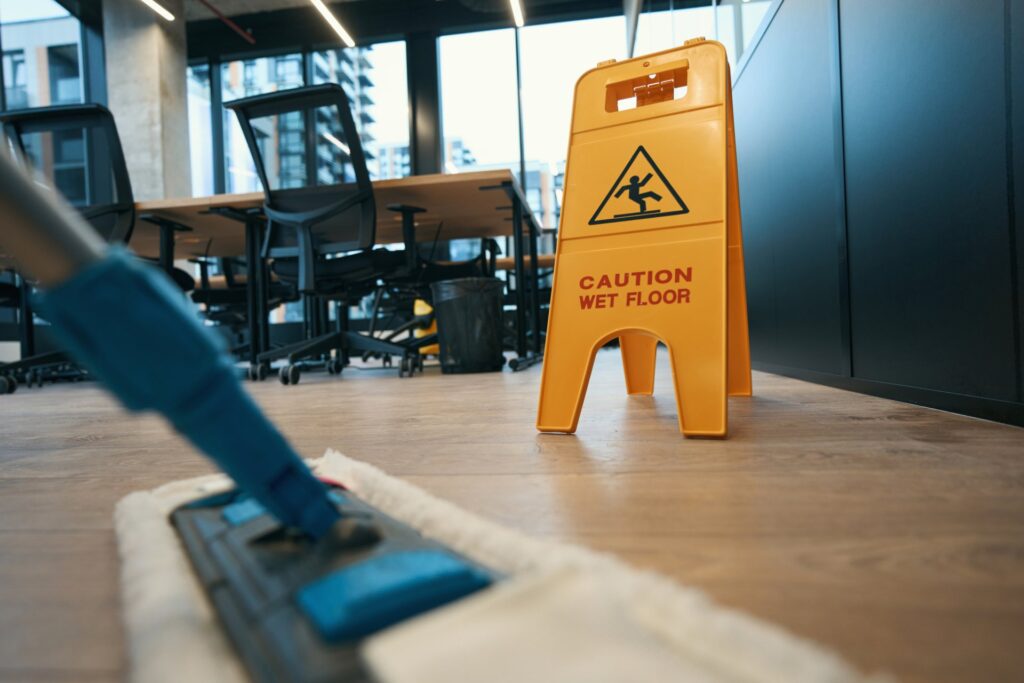
Daily tasks are the backbone of any cleaning programme. They prevent the accumulation of dirt and bacteria that makes a space feel neglected, and they keep your highest-traffic zones safe and presentable for staff and visitors every single day.
Workstations and open-plan areas
Workstations carry a surprisingly high bacterial load. Keyboards, mice, telephone handsets, and desk surfaces are touched dozens of times a day and are rarely cleaned as often as they should be.
- Wipe all desk surfaces with a multi-surface disinfectant and a clean microfibre cloth.
- Sanitise shared equipment: telephone handsets, keyboard trays, and any shared monitors or screens.
- Empty and reline all waste bins, including confidential waste bins where applicable.
- Vacuum or sweep all hard floors and vacuum carpeted areas under and around desks.
- Remove any crockery left on desks to the kitchen area.
- Wipe clean all internal glass partitions at hand and face height.
Good to know: The University of South Carolina office routine cleaning checklist (PDF) specifies that desk surfaces and shared touchpoints should be disinfected using EPA-approved products and that operatives should wear appropriate PPE, including nitrile gloves, during the process. This is a standard we follow across all our client sites.
Restrooms
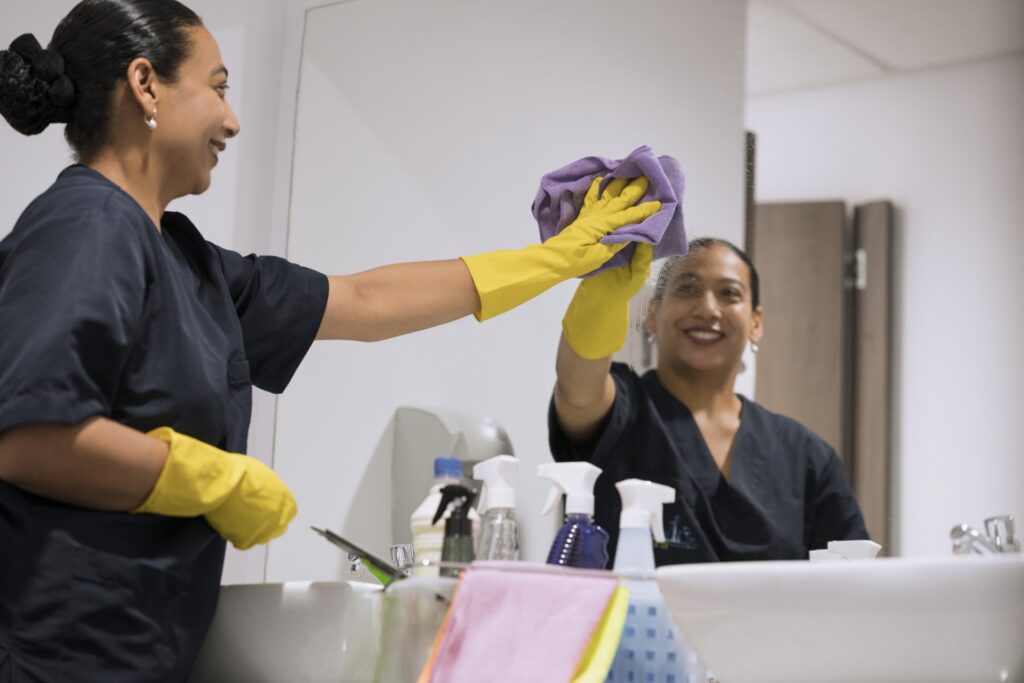
Restrooms require the most rigorous daily attention of any area in the building. The consequences of a lapse here are immediate and visible.
- Clean and disinfect all toilet bowls, seats, and cisterns.
- Wipe down and disinfect all basins, taps, and surrounding surfaces.
- Clean all mirrors with a streak-free glass cleaner.
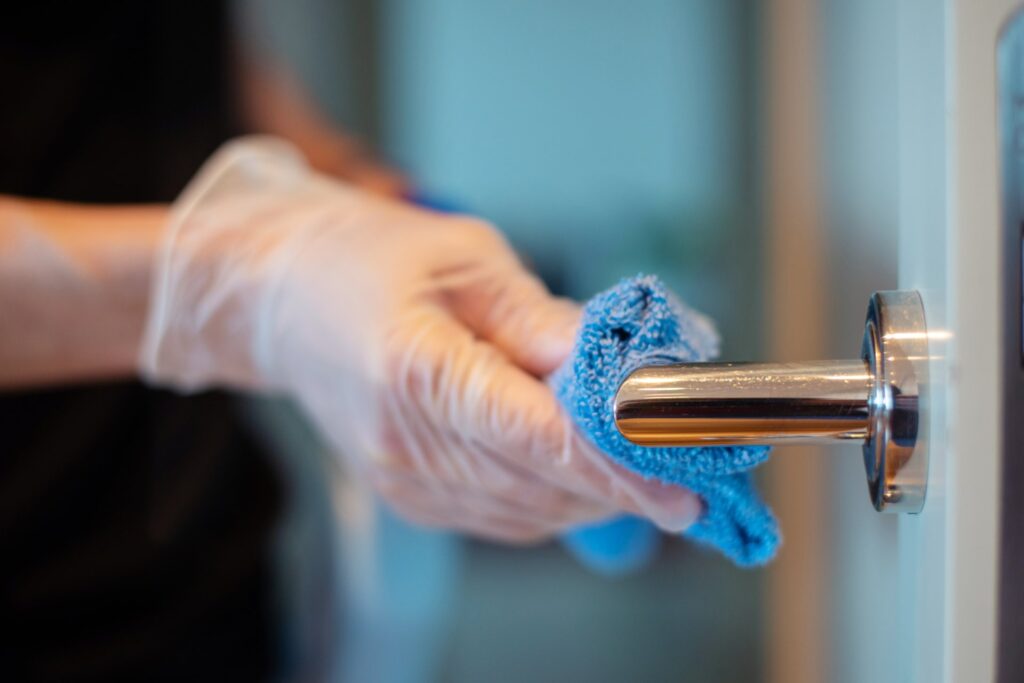
- Disinfect door handles, light switches, and any other high-contact touchpoints.
- Restock soap dispensers, paper towels, and toilet tissue.
- Empty sanitary waste bins and reline with new bags.
- Mop floors with a disinfectant solution.
- Check and replenish air freshener or deodoriser units.
When selecting disinfectants for restroom surfaces, we recommend products from the EPA-registered disinfectants for workplace surfaces list, which confirms efficacy against the most common pathogens found in washroom environments.
Kitchen and break room
The kitchen is often where cleaning standards slip fastest, particularly in shared offices where individual accountability is diffuse. Daily attention here is non-negotiable.
- Wipe all work surfaces and the exterior of appliances (microwave, toaster, kettle, coffee machine) with a disinfectant cloth.
- Clean the inside of the microwave if it has been used.
- Empty and clean the kitchen bin; reline with a fresh bag.
- Wash, dry, and store any crockery left in the sink or on the draining board.
- Disinfect the sink basin and taps.
- Sweep and mop the kitchen floor.
- Replenish washing-up liquid, hand soap, and paper towels.
Reception and entrance areas
Your reception sets the tone. It is the first and last impression every visitor takes away.
- Vacuum or mop the entrance floor, paying particular attention to matting where dirt is tracked in.
- Wipe down reception desks and any seating in the waiting area.
- Polish or clean all internal glazing and entrance doors.
- Empty any bins in the waiting area.
- Arrange magazines, brochures, or any display items neatly.
Weekly office cleaning tasks
Weekly tasks address the gradual build-up that daily cleaning cannot wholly prevent, and they bring areas back to a consistent standard before deterioration becomes visible to staff or visitors.
- Dust all horizontal surfaces at height: windowsills, shelving, top edges of partitions, monitor stands, and filing cabinets.
- Damp-wipe skirting boards and door frames throughout the office.
- Clean and disinfect internal door handles across all areas.
- Deep-vacuum upholstered seating in meeting rooms and break-out areas, including under seat cushions.
- Clean meeting room tables thoroughly, including chairs and any video conferencing equipment surfaces.
- Remove fingerprints and marks from all internal glazing and glass partitions from floor to ceiling.
- Descale kitchen taps and kettle if limescale is beginning to build.
- Wipe the insides of kitchen cupboard doors.
- Clean waste bins themselves (not just reline them), inside and out.
- Check all light switches and wall-mounted sockets for marks and wipe clean.
Monthly cleaning tasks
Monthly tasks are where you address the areas that daily and weekly routines simply cannot reach within their time constraints. These jobs protect the longevity of your fixtures and fittings and maintain the deeper hygiene of the building.
- Clean the interior of all kitchen appliances, including the fridge (remove all contents, wipe shelves and seals, and allow to air).
- Descale shower and wet room facilities if present.
- Damp-wipe all blinds or vacuum fabric blinds thoroughly.
- Wipe down all internal walls and painted surfaces where marks have accumulated.
- Clean the underside of desks and chairs, including removing any accumulated dust from castors.
- Inspect and clean air conditioning unit filters and wipe grilles.
- Polish hard floors using an appropriate treatment for the surface type. Our team provides hard floor cleaning and maintenance as a dedicated service where deeper restoration is needed.
- Carry out a full sanitising clean of all restroom tiles, grout, and drainage channels.
Note on indoor air quality: Monthly attention to ventilation grilles and air conditioning filters has a direct bearing on the air your staff breathe every day. The OSHA indoor air quality guidelines for office buildings confirm that inadequate ventilation and the accumulation of dust and contaminants in HVAC systems are among the leading causes of poor indoor air quality and associated health complaints in office environments.
Seasonal and quarterly cleaning tasks
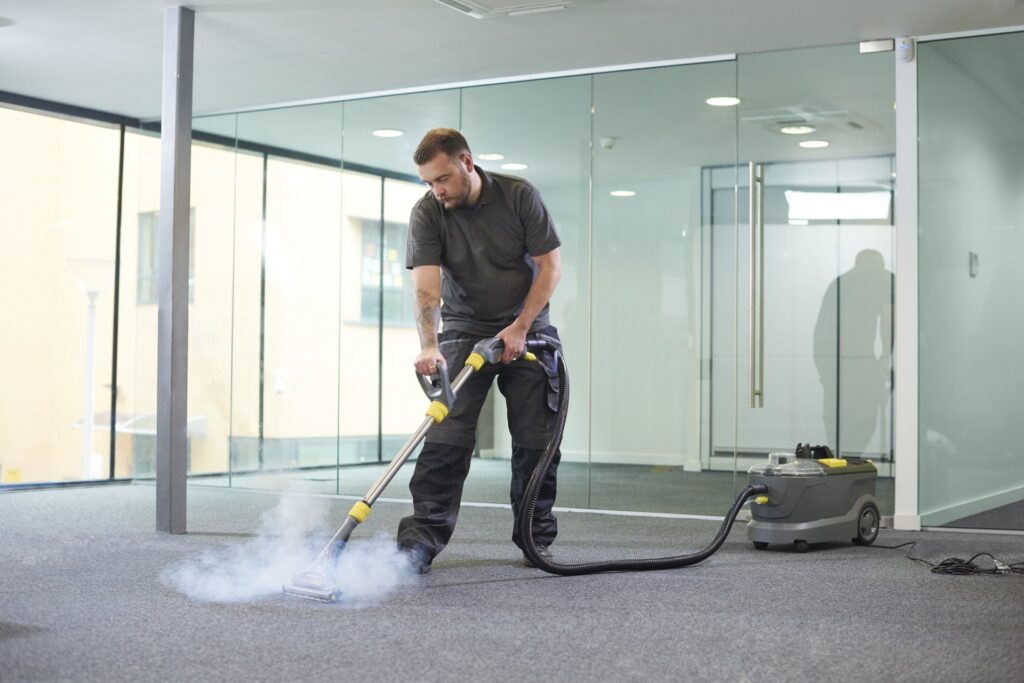
Some tasks simply cannot be completed on a monthly cycle without significant disruption to the working day, but leaving them to chance creates cumulative problems that become expensive to put right. A quarterly or seasonal deep clean addresses these systematically.
HVAC and ventilation
Beyond the monthly filter wipe, a full HVAC inspection and clean should take place at least twice a year: once before the heating season begins and once at the start of summer cooling. This includes duct interiors, fan units, and any filtration systems beyond accessible grille filters.
Carpets and upholstery
Vacuuming maintains carpet appearance but does not extract the allergens, fine dust particles, and bacteria that settle into pile fibres over time. Hot water extraction or dry cleaning of carpets should be scheduled quarterly in high-traffic areas and biannually in lower-use spaces. Upholstered furniture should be treated on the same cycle.
High surfaces and hard-to-reach areas
High-level dusting, cleaning of ceiling light fittings, the tops of tall storage units, exposed pipework, and any ledges above two metres all require specialist equipment and should form part of a quarterly programme. These areas are a significant source of allergen accumulation and, if left, can cause visible fallout onto desks and equipment below.
External surfaces and windows
External window cleaning, cladding, and entrance canopy cleaning are tasks most offices schedule quarterly. Seasonal changes bring specific challenges: autumn leaf matter, winter salt spray from gritted paths, and summer pollen all accumulate differently and may require tailored treatment.
For a real-world example of how a full cleaning programme is planned, resourced, and mobilised across a large commercial property, see this real-world office cleaning case study: global HQ mobilisation project, which documents the process in practice from initial scope through to ongoing daily operations.
Cleaning task frequency at a glance
Approximate average session time (in minutes) for each cleaning frequency tier in a mid-sized office of 50 to 80 people. Annual figures reflect a full professional deep clean. Times will vary based on office size, layout, and specification.
| Frequency | Typical session time | Who typically carries it out | Primary areas covered |
| Daily | 30 mins (per cleaner) | In-house team or contracted daily cleaner | Desks, restrooms, kitchen, bins, floors |
| Weekly | 60 mins | In-house team or contracted cleaner | Dusting, glass, meeting rooms, upholstery |
| Monthly | 90 mins | Contracted cleaner or in-house senior staff | Appliances, blinds, floors, walls, air units |
| Quarterly | 3 hours | Professional cleaning contractor | HVAC, carpets, high surfaces, external glazing |
| Annual deep clean | 8 hours or more | Specialist professional cleaning team | Full building, all areas, all surfaces |
Essential cleaning supplies and PPE
Even the best checklist is only as effective as the products and equipment used to carry it out. Using the right tool for each surface prevents damage, reduces the time each task takes, and ensures the hygiene outcome is actually achieved rather than just approximated.
Cleaning products
Multi-surface disinfectant
Used on desks, hard surfaces, and shared equipment. Choose a product effective against bacteria and viruses and appropriate for use on electronic surfaces.
Toilet and urinal cleaner
A dedicated limescale-removing formulation, separate from general-purpose cleaners, for use exclusively in restroom fixtures.
Glass and mirror cleaner
A streak-free spray for internal glazing, mirrors, and windows. Microfibre cloths or specialist glass cloths give the best results.
Descaler
For kitchen appliances, taps, and shower fittings. Particularly important in hard water areas.
Floor cleaner
The correct product for your floor type: neutral pH cleaners for most hard floors, pH-adjusted solutions for specialist materials such as natural stone or resin.
Carpet spot treatment
A fast-acting pre-treatment for stains, to be applied before any machine extraction clean.
Equipment and PPE
- Microfibre cloths, colour-coded by zone (typically red for restrooms, blue for general areas, green for kitchens) to prevent cross-contamination.
- Vacuum cleaner fitted with a HEPA filter, which captures fine particulate matter rather than redistributing it into the air.
- Mop and bucket system, ideally a two-compartment model to keep clean and dirty water separate.
- Nitrile gloves for all cleaning tasks. Eye protection when working with concentrated chemical products.
- Colour-coded mop heads and handles to mirror the cloth coding system.
The OSHA cleaning industry safety standards and guidelines set out minimum requirements for PPE and chemical handling in professional cleaning contexts. If you manage an in-house cleaning team, these are the reference standards your procedures should meet.
Comparing in-house cleaning with a professional contractor
| Consideration | In-house team | Professional contractor |
| Cost structure | Fixed employment costs plus equipment and supplies | Contracted fee; equipment and products included |
| Consistency | Variable; dependent on individual staff | Structured quality assurance and managed cover |
| Specialist tasks (deep cleans, floor care) | Usually outsourced anyway | Included or available on request |
| Accreditation and compliance | Requires internal management | Contractor holds relevant accreditations (e.g. BICSc) |
| Flexibility to scale | Limited by headcount | Easily scaled up or down with contract changes |
| Management overhead | Higher; HR, training, cover all fall internally | Lower; managed by the contractor |
When to bring in a professional cleaning service
There is a point in the life of most offices where the in-house approach reaches its natural limit. It is not always a crisis that signals this. Often it is a quieter accumulation: standards drift slightly, cover during holidays becomes a problem, a deep clean keeps being deferred, and staff start to notice.
The case for working with a professional contractor is strongest when:
- Your office has 20 or more staff and cleaning requirements have grown beyond what one person can maintain to a consistent standard.
- You operate in a regulated environment (healthcare, food production, legal, financial services) where documented cleaning standards and third-party verification matter.
- You have specialist surfaces or equipment, such as natural stone floors, data centre spaces, or commercial kitchen facilities, that require trained operatives.
- You are planning a refurbishment, a change of tenancy, or a significant office move and need a documented clean to a defined specification. Our end of tenancy cleaning guide covers this scenario in detail.
- Your current provider is not meeting the standard you agreed, and you need a team with the accountability structures to put that right.
We work with clients across a wide range of sectors and building types, from single-floor London offices to large multi-site estates. Our full range of cleaning services includes everything from contracted daily cleaning to specialist interventions, and our Total Clean regional offices across the UK mean we can provide consistent coverage whether your estate is in one city or spread across several.
For organisations in the public sector, we also provide specialist council and public sector cleaning, with the compliance and reporting frameworks those contracts require.
What to look for in a cleaning contractor
Not all contractors are equal. When evaluating providers, look specifically for membership of or accreditation against recognised professional bodies such as the British Institute of Cleaning Science (BICSc), ISO 9001 quality management certification, and evidence of structured training programmes for operatives. Ask how they handle cover for absent staff, how they measure and report on quality, and what their escalation process is when something is not right.
The right contractor does not just clean your office. They give you one less thing to think about, with the documentation and accountability to prove it.
Is a professional deep clean worth it?
For most offices, the answer is yes, and the frequency depends on your environment. High-density open-plan offices, buildings with poor natural ventilation, or workplaces that handle food or client-facing activities daily will benefit from a scheduled professional deep cleaning services programme at least twice a year. Lower-density or remote-working-heavy offices may be well served by an annual deep clean supplemented by a rigorous monthly routine.
The cost of a deep clean is almost always less than the cost of replacing carpets, refinishing floors, or dealing with a washroom maintenance issue that was allowed to develop over time. Prevention is the more economical position, and a structured cleaning programme is how you hold that position.
Frequently asked questions
How often should an office be professionally cleaned?
Most offices benefit from professional cleaning five days a week for daily maintenance, with a deeper professional clean carried out monthly or quarterly depending on footfall, industry, and the number of staff. High-traffic areas such as restrooms and kitchens may require more frequent attention regardless of overall office size.
What is the difference between daily cleaning and deep cleaning in an office?
Daily cleaning covers routine maintenance: emptying bins, wiping surfaces, sanitising touchpoints, and vacuuming. Deep cleaning goes further, addressing built-up grime in areas not reached during regular visits, such as behind equipment, inside appliances, grout lines, air vents, and upholstered furniture.
What cleaning supplies does an office need?
A well-stocked office cleaning kit typically includes multi-surface disinfectant, glass cleaner, toilet and urinal cleaner, descaler, microfibre cloths colour-coded by zone, a vacuum cleaner with a HEPA filter, a mop and bucket, bin liners, and appropriate PPE including gloves and, where concentrated chemicals are in use, eye protection.
Who is responsible for office cleaning?
Responsibility typically sits with the facilities manager or office manager, who either manages an in-house cleaning team or coordinates with a contracted commercial cleaning provider. Regardless of who carries out the work, a documented checklist ensures standards are consistent and accountability is clear at every level.
How do I know when my office needs a deep clean?
Signs that a deep clean is due include persistent odours, visible staining on carpets or grout, a build-up of limescale in kitchen and bathroom fixtures, dusty vents or window blinds, and staff feedback about hygiene. Most offices should schedule a deep clean at least twice a year, or after any significant building work, high-footfall event, or change of tenancy.
Let us take your office cleaning off your to-do list
A thorough checklist gives you the structure. The right cleaning partner gives you the certainty that it is followed, every day, to a standard you can rely on. With over 35 years of experience behind us, we have the systems, the people, and the track record to deliver exactly that. Get in touch for a free, no-obligation quote and we will put together a programme built around your office, your schedule, and your standards.
Related Posts
Total Clean Wins the 2026 BICSc Innovation Award
Read More
Total Clean Named Finalist for the 2026 BICSc Innovation Award
Read More

How Often Should an Office Really Be Cleaned
Read More
